Books

Investment Book Suggestions:

Click on the books’ titles or pictures for more information. Feel free to share titles of books that have helped you, and add the titles to the comments section at the bottom of the page.


For Beginners

These are the books I’d recommend for people who have never read an investment book before.

But don’t mistake simplicity for something substandard.

Following the strategies espoused in these books will, after all taxes and costs, have you beating at least 90% of professional money managers over your investment lifetime.

That’s a fact.


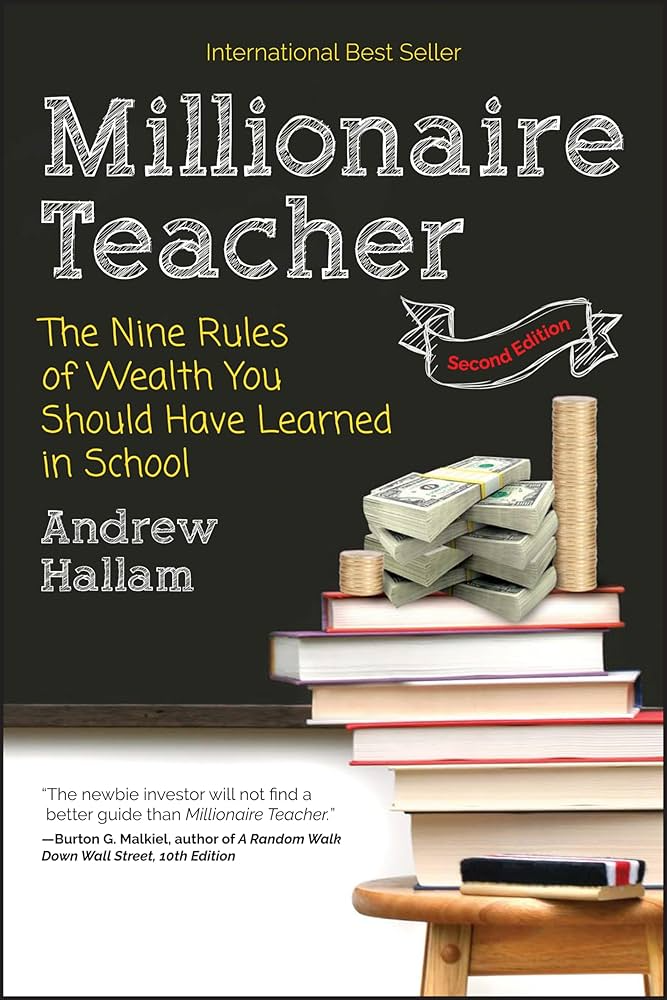
In this book, I explain some essential financial rules that should be taught in schools….but aren’t..

Millionaire Teacher espouses the same investment philosophy as the books below, but there’s a significant difference: it explains how investment theory was actually put into practice. Just three weeks after being released, it ranked number 2 on Amazon’s hottest new personal finance books. I think you’ll like it.

(Read the reviews by the people who’ve purchased it.)

Why not share these Amazon links with your friends:


In an easy-to-read conversational voice, financial planner Bill Schultheis proves why he’s considered one of the heroes of the financial service industry. Promoting a low cost, index fund solution to investing, he guides his readers as if he’s your affable neighbour, explaining the process over coffee. You can enjoy this book from cover to cover in a single afternoon. I’ve gifted many copies of this book at my index fund seminars. You’ll like this book.


Paul Farrell ably introduces this book as something his wife encouraged him to write. As a women “whose eyes usually glaze over” when he starts to talk finance, you get the idea, right away, that Dr. Farrell’s book is aimed at a broad audience, peppered with a fun writing style that’s missing in the vast majority of personal finance books. His message is the same as Bill Schultheis’ but his voice is a tad cheekier. This could be the first and only investment book you’ll ever have to read.


Cheekier still, but every bit as good, is Daniel Solin’s book, The Smartest Investment Book You’ll Ever Read. This immodestly titled book is comprised of only 154 pages, and this leading securities arbitration lawyer guides readers to see that again, index fund investing gives the highest statistical chances of success. With a spacious format, it’s another book you can read in an afternoon while learning how the industry of actively managed mutual fund investing is rigged against the average investor. Like The Lazy Person’s Guide to Investing and The New Coffeehouse Investor, it’s going to make you smile from time to time, if you don’t chuckle out loud.


Perhaps the shortest book of them all, The Elements of Investing was written by investment legends Burton Malkiel and Charles Ellis. As the bestselling authors of A Random Walk Down Wall Street (Malkiel) and Winning the Loser’s Game (Ellis) they’ve teamed together to produce an investment book that’s far simpler to understand than either of their former masterpieces. From what I’ve learned, giving financial seminars, the average person has difficulty understanding terms and jargon that most financial writers take for granted. As great as both of these gentlemen’s other books are, this one is far easier for the average reader to understand.


For Intermediate Investment Readers


I enjoyed Larry Swedroe’s book, The Only Guide to an Investment Strategy You’ll Ever Need and as the title suggests, I think he’s right, although it’s slightly more academic than the previous four books I mentioned. After reading one of the four books I listed above, if you’re still not convinced, and/or you want more meat, then this could be the book for you. Written in 2005, it has the qualities of a great book—because it’s timeless. Read this book twenty years from now, and the theory behind it will remain the same: solid, academically rigorous, relevant and accessible to the average reader.


Swedroe’s new book, The Quest For Alpha: The Holy Grail of Investing is a fabulously convincing read. If you’re still not convinced that index funds offer much higher statistical chances of success, compared to the expensive products peddled by most financial advisors, then this book will very likely change your mind.


Written by a man named by Fortune Magazine as one of the four investment giants of the 20th century, Bogle packs a powerful punch with this little 214 page book. Showing how index funds are superior investment vehicles, he loads the book with evidence and experience drawn from more than 50 years in the investment field. I’ve gifted more than 40 copies of this little book to my colleagues, but I’ve listed it under “intermediate” as a reader, because it has terms that many of my college educated colleagues couldn’t understand, and it had my dad (a fairly well-read fella) running for the dictionary a number of times. Bogle is an academic. But he’s brilliant, a clear writer, and he’s definitely fighting for the little guy.


Written by the legendary finance writer, William Bernstein, both these books both give an extremely solid investment foundation.

If we were to ask Mr. Bernstein himself, he’d probably suggest that we read The Four Pillars of Investing first, and The Investor’s Manifesto second. In the first book, he thoroughly discusses how people madly become euphoric when fad-like investments rise in value without solid fundamentals to back them up.


In Bernstein’s second book, The Investor’s Manifesto, he shows how the same emotional madness can sabotage investor’s accounts when the markets drop in value. What’s more, he does it with an ever-improving flair for imagery and humour:

“Your primary training tool is the rebalancing process, which forces you to sell high in the good years and to buy low when there is blood in the streets. In the really bad years, such as 2008-2009, this will mean pouring large amounts into falling equities, when your friends and family are running around like decapitated poultry.”

Both of these books, of course, promote indexed investing as well.


For Advanced Finance Readers

These are my favorite advanced level  investment books, but unlike some of the books above, they aren’t entertaining for the average investor. And that’s fine. Investing isn’t meant to be fun.

The same message is here that you can read about in Millionaire Teacher, but the evidence here is simply awe-inspiring.


For the most extensively researched books on indexed investing, nothing really compares with John Bogle’s updated 10th anniversary edition of Common Sense on Mutual Funds: New Imperatives for the Intelligent Investor and…


What’s interesting is that David Swensen, Yale University’s endowment fund manager, didn’t intend to write his book, Unconventional Success, about indexed investing.

But the more he researched, the more he realized that the financial service industry exploited individual investors. His book offers a fabulous solution to that problem.


And what about the books you’ve read ? Are there any books that have helped you?


Please add your comments below

Permanent link to this article: http://andrewhallam.com/books/

8 comments

  1. avatar
    Scott Graham says:

    The book that you wrote”Millionair Teacher”
    I feel is a super book, I would like to know what to invest in.
    I’m a 57 year who is currently retired from 3M.
    Thank you for writing trhis book!
    Scott Graham

    1. avatar
      Andrew Hallam says:

      Thanks Scott,

      A great portfolio for you would be simplicity itself. If 3M offers a pension, you coud do this:

      40% Vangaurd total bond index
      30% Vanguard total stock index
      30% Vanguard international stock index

      If you won’t have a pension, you could have 50% or so in the bond index, with the remainder split between the U.S. and international stock indexes. My recommendation is exactly the same as what you read in the book.

      Cheers,
      Andrew

      1. avatar
        Barry says:

        Just having a look, surprisingly the Vanguard international stock index has done well over the last 10 yrs when compared to the Vanguard total stock index

        I would have thought the latter would be the better performer, so was interested to see the results on Vanguard

        1. avatar
          Andrew Hallam says:

          Hi Barry,

          Don’t look at past results, just current costs. It’s the future that you should be far more interested in, not the past. And if your money is diversified, low cost, and gets rebalanced, you’ll do very very well. The best indicators of future performance isn’t past performance. There’s no correlation there. But there is a correlation between low fees and future performance.

          Cheers,
          Andrew

  2. avatar
    Brad says:

    Andrew really the the book Millionaire Teacher. One question how do you feel about target date retirement funds for 401k and Roth IRA plans?

    1. avatar
      Andrew Hallam says:

      Hi Brad,

      I think Vanguard’s target retirement funds are superb. Although, I would pay more attention to the allocation of the bonds and stocks than I would the actual target date, when it comes to selecting which one to buy. I mention them in my book, and mention this in a bit more detail there.

  3. avatar
    Rachael says:

    Hi Andrew

    I read your book over the weekend and thoroughly enjoyed it. I’m a 34 year old recently married British expat living in Singapore. What indexes would you recommend I invest in and what split would you suggest for my portfolio between bonds, UK index and an asian/international index?

    Rachael

    1. avatar
      Andrew Hallam says:

      Hi Rachael,

      Please let me know if you still have questions after reading this link: http://andrewhallam.com/2010/11/how-british-expatriates-can-invest-using-index-funds-in-singapore/

      Cheers,

      Andrew

Leave a Reply

Your email address will not be published.